There are over 100,000 peer-reviewed studies on mycorrhizal fungi in the scientific literature. That's not a marketing claim. It's one of the most extensively researched plant-soil relationships in biology. So when growers ask whether mycorrhizal inoculants actually work, the answer isn't anecdotal. It's backed by decades of field and laboratory data across hundreds of crop types.
This article covers what the research actually shows: specific, measurable benefits documented in peer-reviewed studies, along with what conditions produce the best results. If you're new to mycorrhizae and want to understand the biology first, start with our overview of what mycorrhizal fungi are and how they work. If you're ready to see the numbers, read on.
Benefit 1: Higher Yields Across a Wide Range of Crops
The most cited benefit of mycorrhizal inoculation is increased plant productivity. Dr. Mike Amaranthus, a former USDA Forest Service Soil Ecologist with four decades of mycorrhizal research, has consistently documented yield increases of 5 to 30 percent across a broad spectrum of plants and conditions.
These aren't cherry-picked results from ideal lab conditions. The gains hold up in the field, including in challenging conditions like saline soils and heavy clay where conventional fertility programs often fall short. The mechanism is straightforward: mycorrhizal hyphae extend the effective root surface area of a plant by orders of magnitude, accessing phosphorus, nitrogen, zinc, iron, and other nutrients in parts of the soil that roots alone cannot reach.
In one study with potatoes, Dr. Amaranthus documented equivalent or higher yields with 30 to 50 percent less phosphorus fertilizer when mycorrhizal inoculant was applied. For commercial growers, that's not just a yield story. It's an input cost story.
Benefit 2: Dramatically Improved Drought Resistance
Water is the most constrained resource in modern agriculture. Globally, 70 percent of all freshwater use goes to crop production. Mycorrhizal fungi offer a meaningful lever for improving water-use efficiency.
The hyphae of arbuscular mycorrhizal fungi (AMF) penetrate microscopic soil pores and fissures that plant roots are physically too large to access. They absorb water from these reservoirs, transport it back to the root, and release it to the plant during periods of drought. The result is measurable: research on mycorrhizal inoculation in drought-stressed crops has documented reductions in water requirements of up to 50 percent per gram of dry matter produced.
Studies on turf grass, sorghum, berseem clover, and row crops have all shown that mycorrhizal plants maintain gas exchange, photosynthesis, and growth under water-stress conditions where non-inoculated controls show significant decline. For turf managers, this translates to maintaining green cover through dry periods. For row crop farmers, it means plants that keep producing when conditions turn dry.
See our research summaries on mycorrhizal drought resistance in turf and mycorrhizal effects on sorghum under drought conditions.
Benefit 3: Suppression of Root Disease
A less widely discussed but well-documented benefit of mycorrhizal colonization is resistance to fungal root pathogens. Mycorrhizal fungi release suppressive exudates into the rhizosphere that inhibit infection by harmful pathogens including phytophthora, fusarium, pythium, and rhizoctonia.
The mechanism is partially competitive: a root system that is already densely colonized by beneficial fungi leaves less opportunity for harmful fungi to establish. Research has also documented direct suppression, where mycorrhizal exudates inhibit pathogen germination and growth. Tomato plants linked by mycorrhizal networks have been shown to share defensive molecules that protect against Alternaria solani, a common soil pathogen.
For growers dealing with recurring root disease pressure, mycorrhizal inoculation is not a replacement for an integrated disease management program. But it is a meaningful biological tool that reduces pathogen opportunity while simultaneously improving plant health.
Benefit 4: Better Establishment Under Stress
The transplant window is one of the most stressful periods in a plant's life. Roots are disrupted, the surrounding soil is unfamiliar, and the plant has not yet established the water and nutrient pathways it needs to thrive. Mycorrhizal inoculation applied at transplant directly addresses this vulnerability.
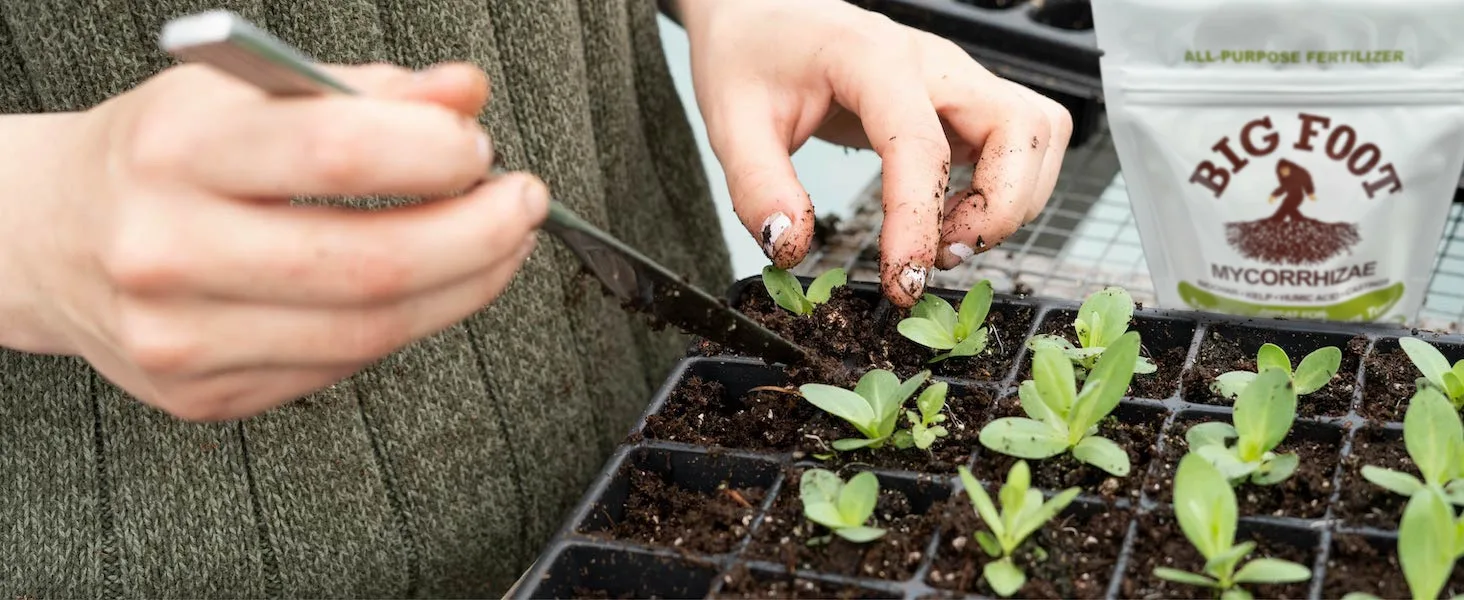
When mycorrhizal spores are in contact with the root at planting, colonization begins as soon as the root is active in the new soil. The fungal hyphae begin extending into the surrounding medium within days, accelerating the plant's ability to access resources before its own root system has had time to expand. The result is faster establishment, less transplant shock, and better survival rates in both commercial and home growing contexts.
This is why application timing matters. The closer the inoculant is to the root at planting, the sooner colonization begins. See our guides on transplanting with mycorrhizae and soil drenching for established plants.
Benefit 5: Carbon Sequestration and Soil Health
Mycorrhizal fungi produce a compound called glomalin, a sticky glycoprotein that binds soil particles into stable aggregates. Glomalin is composed of approximately 40 percent carbon and may account for as much as one-third of the world's soil carbon. A single acre of mycorrhizally active soil can sequester an estimated 1,000 pounds of carbon per year.
Beyond carbon storage, glomalin improves soil structure by creating the aggregate stability that gives healthy soil its characteristic tilth. Aggregated soils drain better, hold more air, resist compaction, and retain moisture more effectively than soils without biological activity. The mycorrhizal relationship, in this sense, is not just a benefit to individual plants. It is a building block of functional soil ecosystems.
When Mycorrhizal Inoculants Work Best
Mycorrhizal inoculants are most effective when the native soil mycorrhizal population has been reduced or disrupted. This is extremely common in modern growing conditions. Tillage tears apart existing fungal networks. Synthetic fertilizers at high rates suppress mycorrhizal colonization because plants stop investing in fungal partnerships when nutrients are already abundant. Fungicides, pesticides, and soil fumigants kill fungal populations directly. Urban soils, potting mixes, and highly managed agricultural ground are often mycorrhizal deserts.
In these conditions, inoculating at planting gives plants access to a biological resource they would otherwise go without. In soils with robust native mycorrhizal populations and minimal disturbance, the benefit of adding inoculant is smaller. Most modern production environments fall squarely in the first category.
Note that some plant families do not form mycorrhizal associations: brassicas (cabbage, broccoli, kale), chenopods (beets, spinach, chard), and a few others. For everything else, the research supports inoculation as a sound agronomic practice. See the complete list of plants that benefit from mycorrhizae.
Dr. Amaranthus spent over 40 years researching mycorrhizal fungi as a USDA Forest Service Soil Ecologist and associate adjunct professor at Oregon State University. He received the USDA Highest Honors Award for scientific achievement and founded Mycorrhizal Applications, the company behind Big Foot Mycorrhizae. His field research underpins much of what practitioners know about mycorrhizal inoculation in agriculture and restoration.
Frequently Asked Questions
Do mycorrhizal fungi actually work?
Yes. Mycorrhizal fungi are among the most studied plant-soil relationships in science, with over 100,000 peer-reviewed studies documenting their effects. Research consistently shows measurable benefits including yield increases of 5 to 30 percent, improved drought tolerance, suppression of root pathogens, and faster transplant establishment. Results are strongest in soils where native mycorrhizal populations have been depleted by tillage, synthetic fertilizers, or fumigation, which describes most modern growing environments.
What are the main benefits of mycorrhizal fungi?
The main documented benefits of mycorrhizal fungi are: (1) increased nutrient uptake, particularly phosphorus, nitrogen, and micronutrients; (2) improved drought resistance through extended water access in microscopic soil pores; (3) suppression of fungal root pathogens like fusarium, pythium, and phytophthora; (4) faster establishment after transplanting; and (5) improved soil structure through glomalin production, which aggregates soil particles and sequesters carbon.
How much do mycorrhizal fungi increase yield?
Research has documented yield increases of 5 to 30 percent from mycorrhizal inoculation across a wide range of crops and conditions. The range varies by crop type, soil condition, and how depleted the native mycorrhizal population is. In one documented case with potatoes, equivalent yields were achieved with 30 to 50 percent less phosphorus fertilizer when mycorrhizal inoculant was applied. Results tend to be strongest in disturbed or heavily managed soils where the native fungal population has been reduced.
Are there any downsides to using mycorrhizal inoculants?
There are very few downsides to using mycorrhizal inoculants. They are safe for plants, soil, humans, and animals. The main consideration is that some plant families do not form mycorrhizal associations (brassicas, chenopods, and a few others), so inoculation has no effect on those crops. High rates of synthetic phosphorus fertilizer can suppress mycorrhizal colonization, so reducing phosphorus inputs or timing inoculant application away from heavy fertilizer applications improves results. Some systemic fungicides can also interfere with colonization.
How long does it take for mycorrhizal fungi to work?
Mycorrhizal spores begin germinating and colonizing plant roots within days of application when conditions are right: adequate moisture, soil contact, and an active root system. Initial colonization establishes within 2 to 4 weeks. Measurable growth and yield effects typically become visible 4 to 8 weeks after inoculation, though benefits compound over the full growing season as the fungal network expands. For the fastest results, apply inoculant directly to the root zone at planting or transplanting rather than broadcasting on the soil surface.
Can mycorrhizal fungi help with drought?
Yes. Mycorrhizal hyphae are approximately 1/25th the diameter of a human hair and can penetrate microscopic soil pores that plant roots are too large to access. This gives mycorrhizal plants access to water sources unavailable to non-inoculated plants. Research has documented reductions in water use of up to 50 percent per gram of dry matter produced in mycorrhizal versus non-mycorrhizal plants under drought conditions. Studies across turf grass, sorghum, clover, and other crops confirm that mycorrhizal inoculation measurably improves survival and productivity under water stress.
Put the research to work in your soil.
Big Foot Mycorrhizae offers granular, concentrate, and gold formulas for every crop type and application method. OMRI listed for organic production.
Shop Big Foot Mycorrhizae