By Mike Amaranthus Ph.D and Paul Hepperly Ph.D
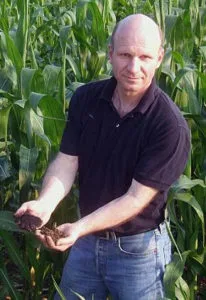
Professor Johannes Lehmann of Cornell University is a soil scientist who became familiar with biochar -- or "terra preta do indio" -- as a visiting scholar in Brazil. He has been one of the principal proponents of the value of extending the ancient work of using carbon for restoring soil productivity. Now he is working with teams of interested collaborators to extend this truth into an energy system which can counteract issues related to global climate change from greenhouse gases both as renewable energy and for its soil sequestration potential.
Making Soil More Fertile
Biochar is a powerhouse example of the potential of transforming soils. This potential was manifested in the terra preta soils of Brazil. Literally translated, these are the "dark soils of the Indians." These pre-Columbian soils developed on depleted oxisols with extremely low carbon content. Under the recycling of organic wastes and chars around these villages, soil became deep and fertile with carbon estimates reaching over 300,000 kg/ha -- far above anything in the surrounding non-biochar transformed soils.
The top A horizon of terra preta have soil organic matter levels at 13-14%. These Indian-created soils were the focus for food production and the retention of nutrients in these tropical and heavily leached soils. The terra preta soils of Brazil have been discovered on an area superior to the modern country of France -- indicating the potential of extensive modification without any modern technology at all.
Biochar Meets Mycorrhizae
Biochar and mycorrhizae -- two "hot" research trends among agronomy scientists -- are beginning to converge in an effort to help address the various challenges posed by global warming and modern non-sustainable agricultural practices.
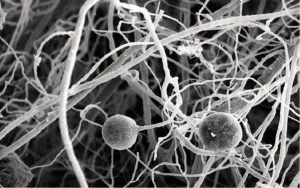
Mycorrhizal fungi form a symbiotic relationship with approximately 80-90% of the world's plant species and have thrived on planet Earth for approximately 460 million years. The soil colonized by mycorrhizal fungi rapidly accumulates glomalin, thus sequestering air-derived organic carbon and stimulating soil productivity. Glomalin is made up of 30-40% carbon, resists decomposition for up to 42 years, and can comprise up to 40% of the total carbon found in soil.
Compounding Cumulative Soil Benefits
So where is the convergence? Biochar and mycorrhizae both augment soil sustainability and they both implement substantial long-term carbon sequestration. The bonus is that combining these two remedial agents apparently compounds their cumulative beneficial properties into a powerful "2 + 2 = 5" soil scenario. In other words, the sum of the benefits exceeds that of each of the contributors.
Researchers say biochar contributes to pro-mycorrhizal soil environments via multiple mechanisms:
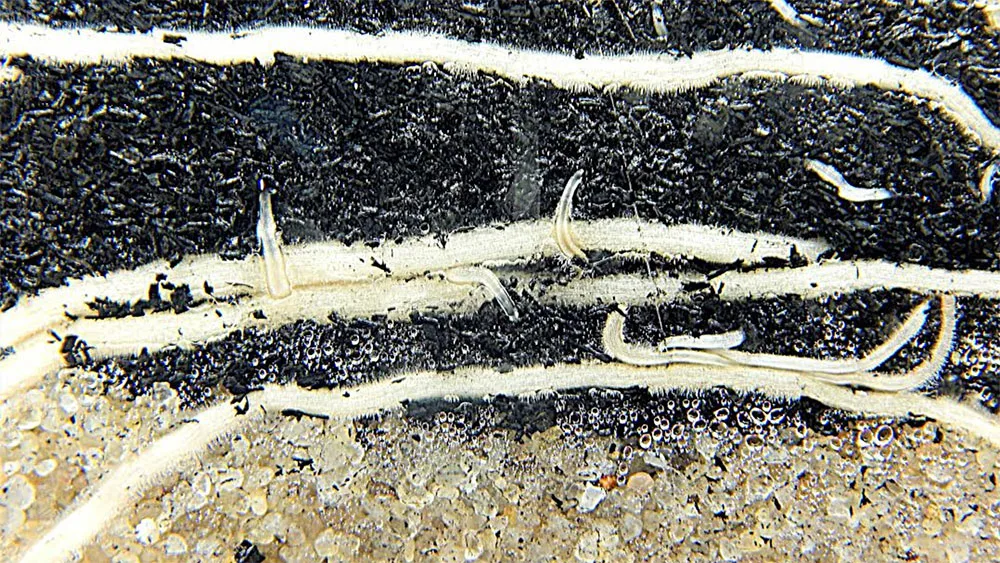
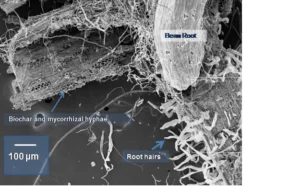
- The myriad tiny pores on biochar particles may serve as physical "shelters" for mycorrhizal hyphae and various symbiotic bacteria, protecting them from damage and microbial predators. Biochar might be envisioned as a soil apartment complex -- mycorrhizal filaments aggressively colonize bits of biochar in soils.
- Biochar appears to modify soil pH, cation exchange capacity (CEC) and water-holding capacity, creating a more favorable environment for mycorrhizal activity.
- Biochar seems to promote microbial populations, which further stimulate mycorrhizal performance.
So far, the majority of studies indicate that mycorrhizae-colonized plants grown in biochar-treated soils significantly outperform non-biochar controls.
A Living Soil for the Future
Much more research is needed, but perhaps the soil management tools of the future will include both mycorrhizal inoculants and biochar amendments -- a combination simultaneously addressing two vital global issues: agricultural sustainability and atmospheric CO2 mitigation.
Our approach is an organic, biologically based strategy for managing soils. It is an approach that improves rather than degrades the productive capital of soil. This is exactly why the soil and its creatures need to be seen as our allies and not as our enemies. The potential of biochar, mycorrhizae, and a living soil are enormous and key to a sustainable future for generations to come.