
Strawberries are among the most mycorrhizal-responsive plants in the fruit garden. They form deep endomycorrhizal partnerships naturally, and in production settings, that relationship directly affects fruit size, runner production, and the plant's ability to handle stress. When you're transplanting bare-root crowns or plugs into beds that have been tilled, fumigated, or built from potting mix, the native mycorrhizal population is often depleted or absent. Inoculating at planting fills that gap from day one.
This guide explains why strawberries respond so well, the right time to apply, and what you can realistically expect over the season.
Why Strawberries Are Excellent Mycorrhizal Hosts
The strawberry root system is naturally shallow and fibrous — well-suited for partnership with arbuscular mycorrhizal fungi, which extend their hyphae into the same surface soil zones the plant depends on. Phosphorus availability in that zone drives early fruit development and runner production. Mycorrhizal hyphae access phosphorus bound in soil chemistry that plant roots simply can't reach, delivering it directly to the plant in exchange for sugars.
Research on commercial strawberry production consistently shows that mycorrhizal colonization improves plant biomass, increases phosphorus concentration in leaf tissue, and in some trials results in measurably higher fruit yields per plant. The effect is most pronounced in fields with low native AMF populations — exactly the situation after soil fumigation, heavy tillage, or planting into raised beds built from commercial potting mix.
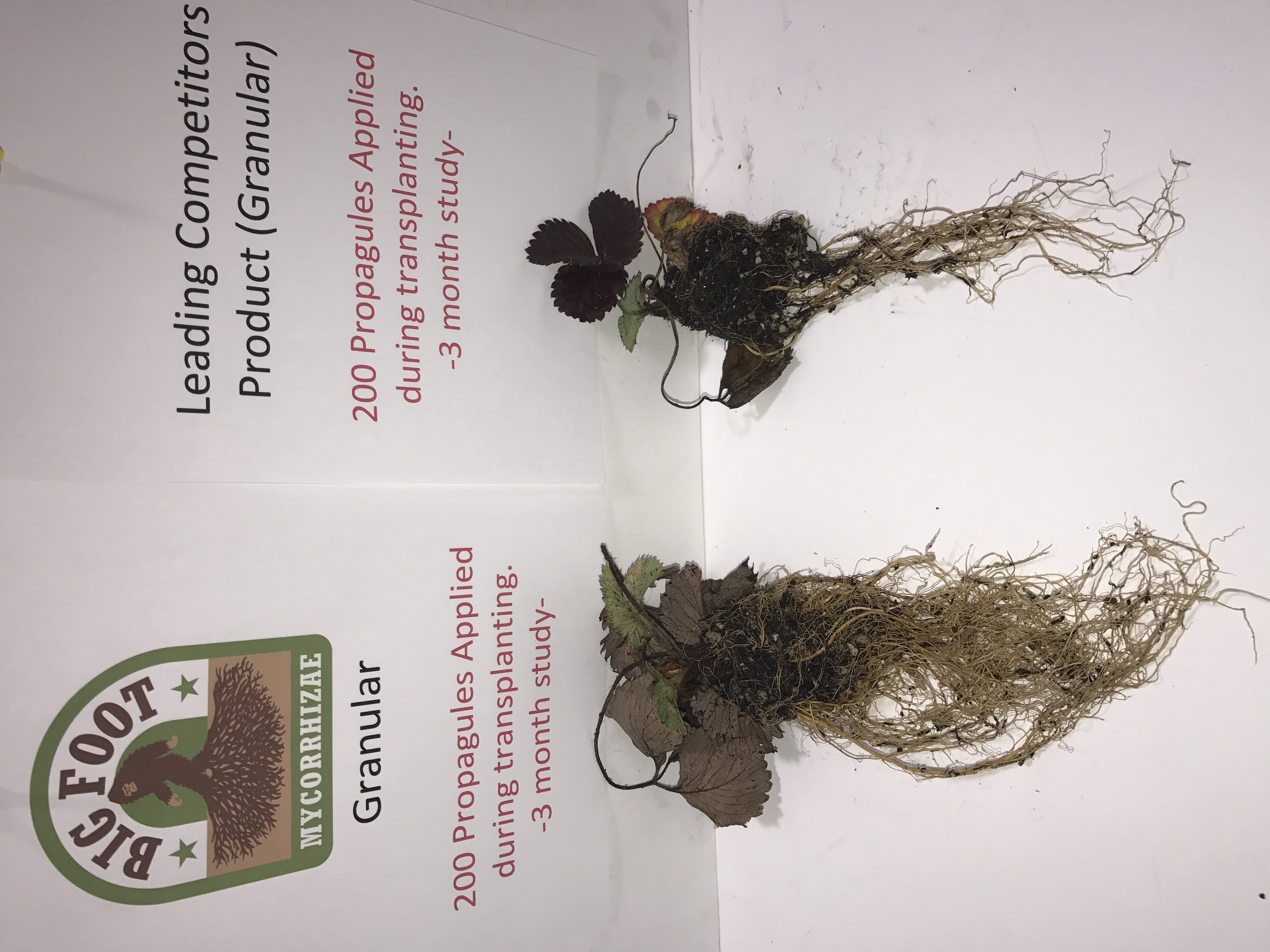
Strawberries grown under high synthetic phosphorus regimes often show weak mycorrhizal relationships because the plant stops investing in the fungal partnership when nutrients are freely available. If your fertilizer program is phosphorus-heavy, you'll see less benefit from inoculation — but also less need for it. The relationship is most valuable when the plant has to work for its nutrition.
When to Apply Mycorrhizal Inoculant to Strawberries
At transplant — bare-root crowns: Dip the roots in a slurry of Big Foot Gold mixed with water before planting, or dust them directly and plant immediately. Root contact at planting is the highest-value application window.
At transplant — plugs or pluglets: Apply a small amount of inoculant into the planting hole, directly below the root ball. The roots will grow into contact with the spores within the first few days.
Established beds: For strawberries already in the ground, apply Big Foot Concentrate as a soil drench around the crown of each plant. The hyphae will find the roots as they spread through the soil. Results are slower than at-planting application but still meaningful, especially before spring growth pushes.
How to Apply: Step by Step
Bare-Root Transplants (Recommended)
- Mix 1 teaspoon of Big Foot Gold into a cup of water to form a thin slurry.
- Dip each bare-root crown into the slurry for 30 to 60 seconds, coating the roots.
- Plant immediately — don't let the roots dry out after dipping.
- Water normally after planting.
Plug Transplants
- Dig the planting hole to accommodate the root ball.
- Drop a half teaspoon of Big Foot Gold into the hole.
- Set the plug so the roots contact the inoculant directly.
- Backfill and water in.
Established Beds (Soil Drench)
Mix Big Foot Concentrate per label directions and apply as a drench around each plant's crown. Apply in early spring before new growth pushes, or after renovation mowing when the root system is actively regenerating. See our full soil drench guide for mixing and application rates.
What to Expect Over the Season
Colonization starts within days of root contact in warm, moist soil. The hyphal network expands steadily through the first four to six weeks. During this period you're less likely to see obvious differences in plant size — the investment is underground. From mid-season onward, the payoff tends to be visible in three ways:
- Faster, more vigorous runner production as the hyphal network extends the plant's reach
- More consistent size and color in the fruit set, driven by steadier phosphorus and micronutrient delivery
- Better drought resilience during dry stretches, as hyphae access water in pore spaces plant roots can't reach
In replanted beds — where old strawberry crowns were removed and new ones planted into the same soil — expect stronger results. The previous crop's hyphae leave behind organic pathways that new colonization can follow.
What to Avoid
- Soil fumigation before planting: Fumigation eliminates both pathogens and mycorrhizal spores. Wait the full post-fumigation window, then inoculate at planting to re-establish the beneficial population.
- High-phosphorus starter fertilizers at planting: Hold off for the first two to three weeks after inoculation. Phosphorus abundance suppresses the mycorrhizal relationship before it can establish.
- Broad-spectrum fungicide drenches early in the season: Some fungicides are safe; others kill mycorrhizal fungi. Check our guide on using mycorrhizae with fungicides before treating.
Which Big Foot Product to Use
For home garden or small-scale planting, Big Foot Gold is the most direct option. One container treats dozens of bare-root crowns or transplants. For larger strawberry patches or commercial rows, Big Foot Granular can be banded at planting time, and Big Foot Concentrate drench-applies efficiently through a watering can or drip system.
Give your strawberry bed a stronger foundation.
All Big Foot products are OMRI listed for certified organic production.
Shop Big Foot MycorrhizaeFrequently Asked Questions
Do strawberries benefit from mycorrhizal fungi?
Yes. Strawberries are endomycorrhizal plants and form strong partnerships with arbuscular mycorrhizal fungi naturally. The relationship improves phosphorus and water uptake, supports runner production, and can increase fruit yield per plant. The benefit is strongest in fumigated fields, raised beds built from potting mix, and heavily tilled soil where native mycorrhizal populations are low.
When should I apply mycorrhizae to strawberries?
The best time to apply mycorrhizal inoculant to strawberries is at transplanting. For bare-root crowns, dip the roots in an inoculant slurry before planting. For plugs, place inoculant in the planting hole so the roots make direct contact. For established beds, apply as a soil drench in early spring before new growth begins or after renovation mowing when roots are actively regenerating.
Can I use mycorrhizae with strawberry fertilizer?
Yes, with one caveat. High-phosphorus fertilizers applied at the same time as inoculation can suppress the mycorrhizal relationship before it gets established, because the plant reduces its investment in the fungus when phosphorus is freely available. Wait two to three weeks after inoculation before applying phosphorus-heavy fertilizers. Nitrogen, potassium, and calcium fertilizers do not interfere with colonization.
Does soil fumigation kill mycorrhizal fungi?
Yes. Broad-spectrum soil fumigants eliminate mycorrhizal spores along with pathogens. After fumigation, the soil is essentially a biological blank slate. Inoculating at planting after the post-fumigation waiting period is one of the highest-value uses of mycorrhizal inoculant, since there is no native population left to compete for root colonization.
How long does it take for mycorrhizae to work on strawberries?
Spore germination begins within days of root contact in warm, moist soil. Initial colonization establishes within two to four weeks. Visible effects on runner production and plant vigor typically appear four to eight weeks after application. The full benefit accumulates across the growing season, with the most noticeable differences often visible during dry spells or at fruit set.